Marius
The Vampire LestatMarius is an ancient vampire whose roles as historian, guardian, and mentor converge in his relationship with Lestat. His long account of the old gods and Those Who Must Be Kept gives Lestat knowledge no one else has shared with him, but Marius does not offer knowledge as a final answer: he insists that Lestat leave, experience mortal life, and keep the secrets of the beings Marius protects.
Identity and Origins
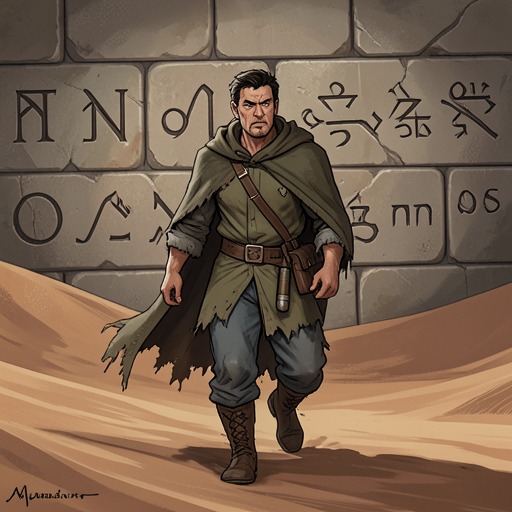
Marius’s history is presented through his own narration, beginning in his fortieth year, when he was a well-traveled scholar in Massilia. He had journeyed through major cities of the Roman Empire, including Alexandria, Pergamon, and Athens, observing people and writing a history of the world. In a crowded waterfront tavern, he continued that work among sailors and travelers, an educated outsider able to move through the world without sharing the circumstances of the poor around him.
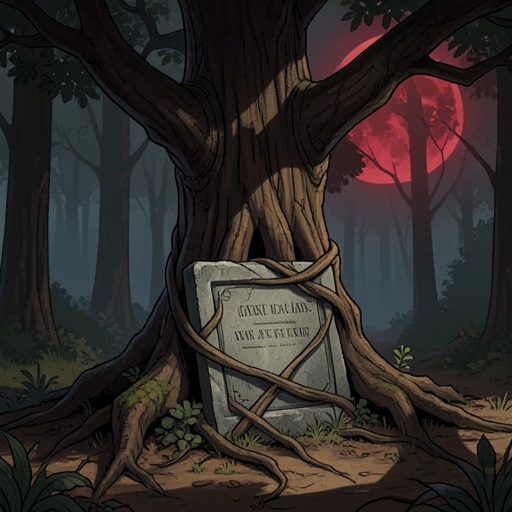
His scholarly life ended when Gauls took him. In a grove, the wounded God of the Grove addressed him as the person who would receive its power. The god promised to make Marius immortal and commanded him to escape its worshipers and travel to Egypt to discover what had happened to the old gods. Its account described a catastrophe: the sun had reached sanctuaries where the gods were hidden and burned them. Some perished, while the surviving ancient beings remained conscious and active in agony. Marius’s transformation was therefore bound from the outset to a charge of investigation and guardianship, rather than to a settled explanation of his new existence.
Custodian and Historian
Marius eventually came into possession of Those Who Must Be Kept, the ancient beings whose identity and history he later discloses to Lestat. He calls this the most important part of his story: how he came to possess them and who they really were. His account ranges beyond that central secret, touching on his loneliness, the immortals he made and lost, and his recurring periods of burial and return, enabled by the blood of Those Who Must Be Kept. The scale of his experience makes him a witness to changing beliefs as well as to vampire history.
Marius explains that, as the Roman Empire declined and Christianity rose, the older pagan gods came to be regarded as demons. The old connections between those traditions were forgotten or misunderstood, and vampires were recast as devils in a new religious age. His narrative thus treats vampire secrecy and religious conflict as historical conditions that change over time: the same beings can be understood through radically different frameworks, while the knowledge that might connect those frameworks becomes dangerous to reveal.
That danger is not abstract. Marius tells Lestat that no one else may learn the location of Those Who Must Be Kept. He requires a promise that Lestat will not reveal them, recount the legends of the old gods, or disclose that he has seen Marius. The prohibition reflects the practical vulnerability of a guardian whose refuge and charges could be exposed. Marius’s knowledge is generous in its transmission to Lestat, but bounded by the obligation to conceal its most actionable details.
The Encounter with Lestat
Marius brings Lestat to him because he wants to share what he knows. Their first contact is marked by a physical touch that feels unusually firm to Lestat, and Marius explains that Lestat has attracted him for several reasons. He offers knowledge about vampires and Those Who Must Be Kept, while explicitly warning that he cannot supply ultimate answers about the creation of the world, humanity, or vampires themselves. What he can provide is a fuller account of their kind and of his own survival. The distinction establishes Marius as a teacher with limits, not an oracle who can resolve every mystery.
Lestat responds with fascination and the possibility of overwhelming love. Their bond is intimate, but Marius’s mentorship is also corrective. He tells Lestat that the younger vampire has not yet lived a complete human life: as a mortal, Lestat experienced no more than six months in Paris, and afterward he roamed as an outsider among other people’s houses and lives. Marius contrasts this with his own successive periods of ordinary life. After taking Those Who Must Be Kept from Egypt, he lived for years in Antioch as a wealthy Roman scholar, with a home, servants, and the love of Pandora; later he found a place in Venice and eventually ruled over the people on his island. Those experiences, he argues, gave him strength for later existence.
Separation and Instructions
Marius’s conclusion is that Lestat must leave and live a complete lifetime among mortals. He warns that avoiding this experience could lead Lestat to despair, retreat into the earth, and perhaps never rise again. The advice makes mortality an essential experience rather than a temporary condition to be dismissed: to endure immortality, Lestat must know human life and its ending from within. Marius directs him to Louisiana, where he is to see his father through the end of his life and learn from witnessing a mortal grow old and die.
Their separation is painful for both. Lestat resists leaving and remembers earlier admonitions that communion is possible only with the old vampires, feeling that he has finally found such communion in Marius. Marius, in turn, says that he wants Lestat to stay but insists that life is elsewhere. He promises to find Lestat when the time comes. His decision also reflects his own need to move: Europeans are entering the waters near his refuge, and their digging at Pompeii had already driven him from an earlier hiding place. He cannot remain where mortals may uncover what he protects, and he cannot risk Lestat or anyone else knowing the location of Those Who Must Be Kept.
The departure takes place after the chapel’s sacred objects have been destroyed and Marius says that the disturbance must be quieted. He puts an arm around Lestat’s shoulder, carries Lestat’s valise, and walks him to the door, urging him to remember the knowledge they shared rather than Marius’s anger. When Lestat worries about the reaction of the being disturbed by his presence, Marius reassures him that this has happened before and that time will allow the being to return to its usual state. The gentle escort makes the break neither simple rejection nor an abandonment of their bond: Marius sends Lestat away because he believes it necessary, while preserving the promise of a future meeting.
Narrative Role and Legacy
Marius’s account supplies both a history and a rule for the story’s present. He explains the origins of the ancient vampires as he understands them, traces how religious change altered their public meaning, and shows why the oldest secrets must remain hidden. At the same time, his intervention changes Lestat’s immediate course: rather than remain in the protected company of an ancient vampire, Lestat is instructed to enter mortal life and confront its limits.
The novel later returns to Marius through Lestat’s attempt to reach him. After pride and old bitterness have kept Lestat from calling, he closes his eyes and silently sends a call into the distance, recalling the nights when he spoke aloud to Marius in Cairo or Rome. The response is not a conversation but a brief image: a snowbound place, an icy stone dwelling, and a modern antenna turning on a high promontory. The glimpse suggests that Marius remains far away and concealed, while the remembered call confirms that separation has not erased Lestat’s attachment. Marius’s influence therefore persists both as the knowledge he imparted and as the distant, guarded presence to which Lestat still reaches.